Monday, 4 January 2016

Music pitch notation

Pitches on the treble and bass staves:

Music is most commonly notated using the Staff. The staff consist of five horizontal lines on which musical notes lie. The lines and the spaces between the lines represent different pitches.
Each line of the staff represents a pitch. In music the pitch of a note means how high or low a note is. The pitch of a note can be measured in a unit called Hertz.
For example a note that is vibrating at 256 Hz will be caused by sounds waves that vibrate at 256 times a second.
This will be Middle C on the piano.
With the blank staff we can't tell what notes to play. We use Clefs to tell us which notes correspond to which lines or spaces. The most common clefs are the Treble Clef ( also known as the G Clef) and the Bass Clef ( or F Clef ).

The Treble Clef spirals around the second line from the bottom. This spiral tells us that notes on this line are G.


From here we can figure out the other names simply by going forward or backward through the musical alphabet: A,B,C,D,E,F,G.


Note: Pitches can also be given the name of Do,Re,Mi,Fa,Sol,La and Ti.
After "G", the alphabet starts over again with the letter A.
Since the treble clef staff is always stacked on top of the bass clef staff, you know that pitches on the treble staff are higher than pitches on the bass staff.


An easy way to remember the pitches on a staff is to memorize the lines and spaces. On the treble staff, the names of the spaces spell the word FACE. It's easy to remember the treble staff lines if you memorize a saying. The first letter of each word in the saying is the pitch name of a line--Every Good Boy Deserves Fudge.


If we need more notes above or below the staff we add Ledger Lines, which extend the range of the staff. (Middle C is the first ledger line below the staff in Treble Clef.)


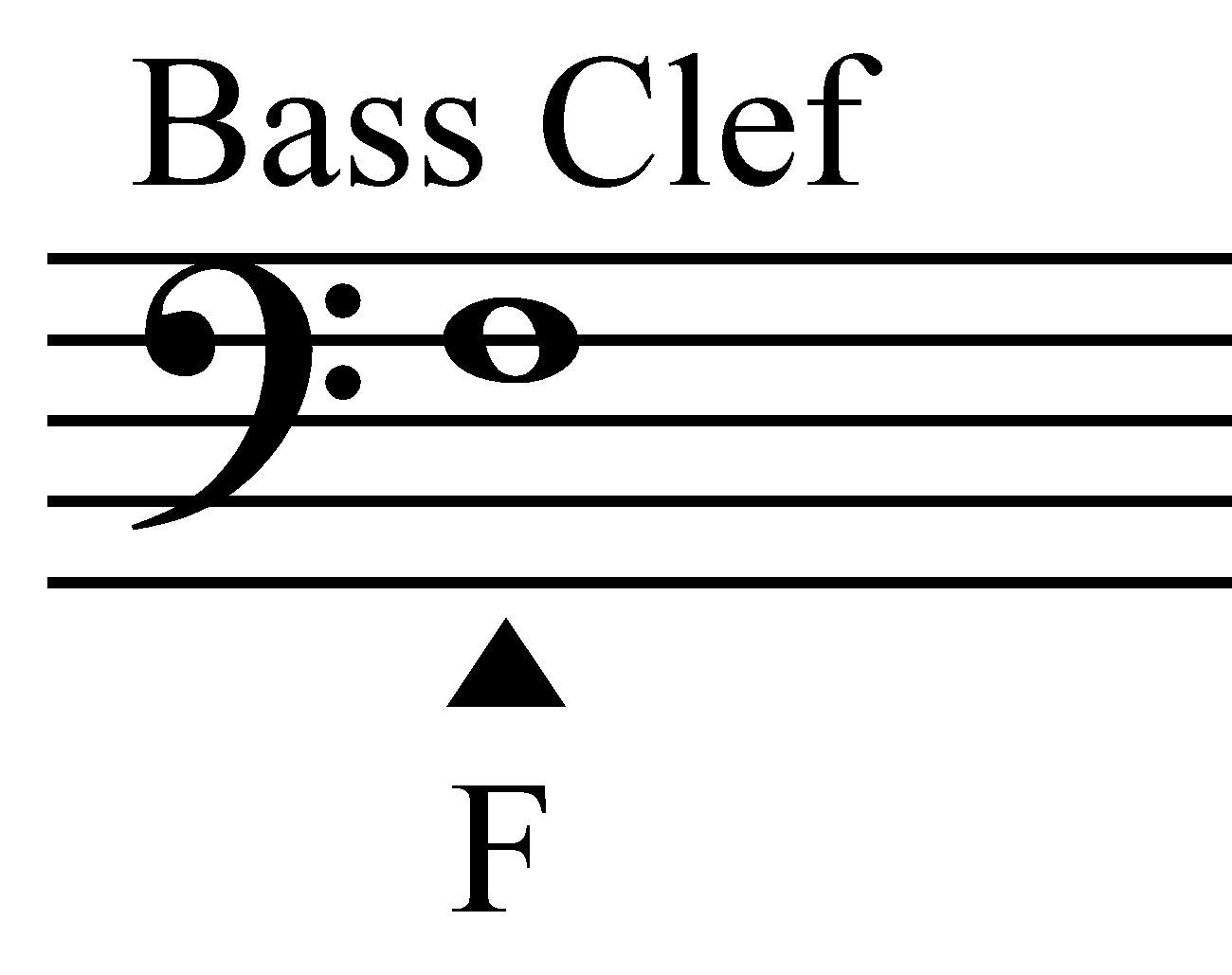
The Bass Clef has two dots, above and below the second line from the top. The dots tell us that this line is F.


The note names in Bass Clef are:


Middle C is the first ledger line above the staff in Bass Clef.


There is an easy way to memorize all the lines and spaces on the bass staff. In the diagram below, you will find the two sayings that will help you remember the names of the spaces and the lines.
As I mention before there are two other Clefs.
Their names are: Alto and Tenor.
The Alto and Tenor Clefs have two curves that meet in the center. The line on the staff where these curves meet is the note C. These clefs are also called C Clefs for this reason.
The Alto Clef is positioned on the middle line. This line becomes the note C. (This note is also Middle C.) 

The note names in Alto Clef are:

Tenor Clef is very similar to Alto Clef but the main difference is that the Tenor Clef is positioned on the second line from the top whereas Alto Clef is positioned on the middle line. In Tenor Clef the second line from the top becomes the note C. (This is also Middle C, just like in Alto Clef.) The note names in Tenor Clef are:


Saturday, 28 November 2015

Music Composition Reflection

Due to technological problems I'm not able to post a recording of my composition.
I think I did a good job.
Everything in my composition was purely from my mind.
During these three weeks I did lot's of research ( which is also post in the Blog ).
 I think I always managed my own behaviour, I concentrated/focus in lessons. I tried ignoring annoying people messing around in class, so i could focus. I always had self motivation, I though positively even when I though I wasn't able to do something.
Mainly, in my composition I used repetition.
In the first week I researched about classic music.
In the second week, I decided what the main chords for my music are and I figured out what the first part of my composition is.
In the third week I decided what the rest is.

Research on Classic Music ( Defining Classical Music and History and Evolution of Classical Music)

For my composition I have choose classical music, so I decided to research on it.


While many now think of Classical music as stodgy and stiff, the style itself began as a rebellion against the heavy influence of the Church in music. Classical music gave audiences a complete idea to the power of newly perfected instruments.

Defining Classical Music

Classical music is a tricky genre, mainly because to the uninformed everything before jazz sounds like it! Indeed, Classical music and Baroque music both use orchestras to produce their distinctive sounds, but the way in which each does it is truly different. For example, Baroque music is very heavy, whereas Classical music is light, almost airy. 
Indeed, Classical music greatly emphasized homophonic melodies, meaning that there was a single melody that all the instruments played, instead of the layered melodies of the Baroque period. This allowed for Classical pieces to be much more powerful, whereas Baroque pieces were just pretty in comparison. 

History and Evolution of Classical Music

Following the death of J.S. Bach in 1750, composers began to rebel against the strict rules of Baroque music. Particularly, they were tired of the overly-intricate stylings of layered melodies that could only display so much technical mastery. In short, the composers knew that their musicians, and themselves, were capable of so much more. 
As such, music during this period moved away from the ornate nature of music before, instead searching for clarity. Often, there would be only one melody, and this was played with each instrument contributing its own range and voice to the piece as a whole. 
With this newfound clarity came a period of extensive growth for one innovation of Baroque music that the Classicists were loathe to rid themselves of: the opera. Suddenly, with precision of music, the story of the characters could become more pronounced, allowing dramatic interest to be complimented by pointed musical contributions rather than dictated by heavy melodies. 


Saturday, 10 October 2015

Moby - Why does my heart feel so bad?

L.O: Moby and his approach to writing music, how "Why does my heart feel so bad" is constructed through an analysis of the music, and some of the technology commonly used in club dance music.
Link to Moby's "Why does my heart feel so bad" - https://www.youtube.com/watch?v=o1Xsj9-3Pvo

EQUIPMENT USED:

The tracks on the album ( Play ) that includes the music "why does my heart feel so bad", played by Moby and later recorded and mixed at his home studio. The equipment used includes synthesisers, a sampler, drum machine (Roland TR909), Multi-effects unit (SPX990) and an Emu performance piano sound module.

  • Yamaha SPX990 Multi-effects unit - to apply reverb and delay to tracks.
  • Roland TR909 drum machine - sound source for drum loops.
  • Emu Proformance piano sound module - Piano sound source (there are two piano sounds on the track, one from an old Yamaha synth and another from the Emu).
  • Roland Juno 106 - Synth bass sounds.
  • Yamaha SY22 and SY85 synthesisers - String/synth pad sounds.
  • Akai S3200 sampler - Sampling the vocal sounds off the original record and any subsequent editing. 
ANALASYS:

Chord structure for "Why Does My Heart Feel So Bad" follows as Am, Em, G, D.
Chord (first half) Structure for 'These open door's follow as C, Am, C, Am.
Chord (second half) Structure for 'These open door's follow as F, C, F, C.
Time signature is in 4/4 (four crochet beats in a bar)
Tempo at 98 beats per minute.
Uses reverb and delay (delayed repeat)- the reflection of sound off surfaces to give the impression of space.
Uses sub-bass which has a frequency to low for us human to hear but provides vibrations onto the dance floor so there is an emphasis on the beat so it it easy to dance to.
Use of echoes as vocals are re-triggered (repeated recordings).
Moby's vocal sample has been not clean producing a distorted sound.


Thursday, 8 October 2015

Why does my heart feel so bad reflection

 We were told to try our own version of Moby's Why does my heart feel so bad, and we decided who is going to play what and how in our groups. Leen is playing the xylophone, Elie plays the piano, Manoli is playing bass guitar and I do the melody.
About our flaws, I think the only thing we really need to improve is the melody and the xylophone timing.

Sunday, 20 September 2015

Music Technology

Music Technology


On the last lessons we have discussed the use of music technology. By music technology, we understand any technology used by a musician to help in tasks like composing, recording, mixing or performing. This technology can be for example a device like a computer with an appropriate software.
The use of this kind of technology has some advantages. It is easy nowadays to make digital recordings that can help a composer to review a new music, or during a rehearsal. Also, some of the sounds we hear in modern music wouldn’t be possible without the use of technology.

However, sometimes the use of music technology seems to be too much. Some music sounds ‘too artificial’.

Monday, 14 September 2015

MYP Statement of Inquiry

Technology has changed the way in which we compose, recorded and present music.


Inquiry Question 

What is music technology?

Music technology is a type of music that uses technology. For example, composing a song on a computer.

How has music changed the way in which we develop and record sound?

It changed a lot, nowadays it is easy to use technology to record sound or compose a song,  for example. 


Are we becoming too dependent on music technology?

Yes, I think we are becoming too dependent on music technology.

Does music technology support or devalue live music making?

I think music technology devalues live music mostly because lots of artists nowadays ‘correct their voices’ with technology and once we listen to their real voices, we may be very disappointed...
However there are also some positive sides about using music technology, like digital recording, that can be very useful for a composer or for an artist rehearsing a new song.